AI-Assisted Web Workflows Work Best With Human Taste
AI can accelerate production, but judgment still decides what deserves to ship.
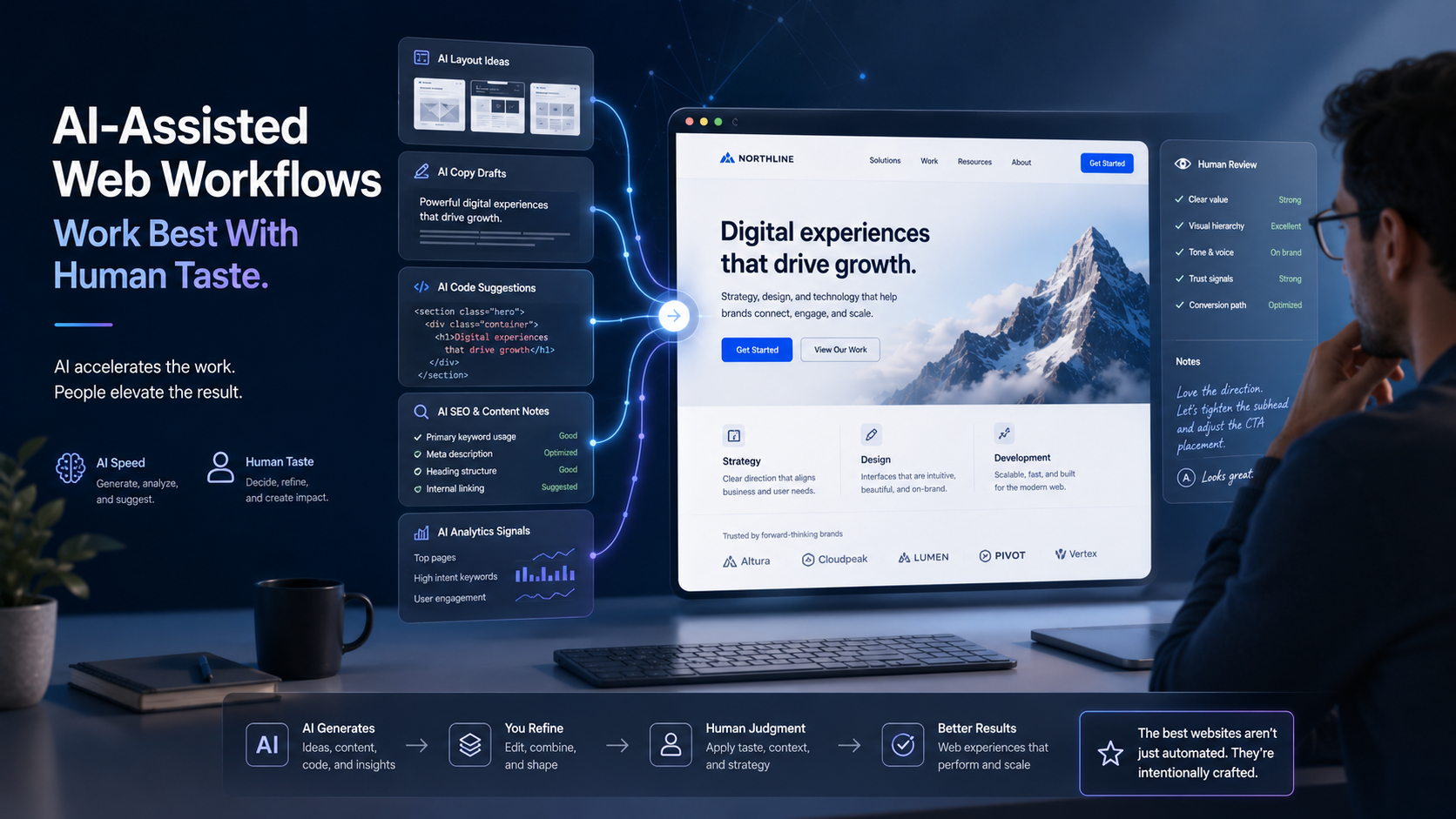
AI can accelerate production, but judgment still decides what deserves to ship.
AI can accelerate production, but judgment still decides what deserves to ship.
That distinction matters.
Web work has always involved a large number of small decisions. Every page requires choices about structure, message, hierarchy, layout, accessibility, performance, calls to action, metadata, imagery, code, testing, publishing, and measurement.
AI tools are very good at helping teams move through those decisions faster.
They can draft copy. Suggest layouts. Generate code. Refactor components. Summarize research. Create content outlines. Produce headline variations. Write schema markup. Generate test scaffolds. Explore visual directions. Identify accessibility concerns. Help with documentation. Turn rough ideas into a working first pass.
That speed is valuable.
But speed is not the same as quality.
A page can be complete and still feel generic. A design can be polished and still feel wrong. A message can be grammatically clean and still miss the buyer. A component can work technically and still create confusion. A website can be full of content and still say very little.
AI helps teams produce more options.
Human taste decides which options deserve to exist.
AI Is Strongest at Momentum
The greatest practical value of AI in web workflows is momentum.
Every project has moments where the team gets stuck. The blank page feels too open. The first version of a service page is hard to start. A developer knows what a component should do but does not want to write boilerplate. A marketer needs ten headline directions before choosing one. A designer wants to explore different content structures before committing to a layout.
AI is useful in those moments because it reduces the cost of beginning.
It can create a first draft quickly. It can turn scattered notes into an outline. It can suggest alternate language. It can convert a design idea into starter code. It can summarize a long discovery call. It can propose FAQ questions. It can help organize a sitemap. It can generate test cases. It can explain a technical tradeoff in plain language.
This does not replace expertise. It gives expertise something to react to.
That is a meaningful shift.
Instead of spending the first hour trying to create something from nothing, a team can spend that hour evaluating, improving, and sharpening. The work moves from blank-page anxiety to editorial decision-making.
For web teams, that is powerful because websites are cross-functional by nature. Strategy, design, content, development, SEO, accessibility, analytics, hosting, and operations all touch the final experience.
AI can help connect those pieces faster.
But it cannot decide what the brand should stand for.
Output Is Not Taste
The biggest risk in AI-assisted workflows is mistaking output for taste.
AI can generate a page. That does not mean the page is good.
It can write a paragraph. That does not mean the paragraph is true to the business.
It can produce a design direction. That does not mean the direction is distinctive.
It can create code. That does not mean the implementation is maintainable, accessible, performant, or appropriate.
This is where teams can get into trouble. AI-generated work often has the appearance of completeness. It may be clean, structured, and confident. It may look good enough at a glance.
But websites are not judged only at a glance.
Visitors arrive with context. They compare claims. They scan for credibility. They notice friction. They sense generic language. They abandon confusing pages. They judge whether the business seems competent and trustworthy.
A page built from generic AI output may technically exist, but it may not persuade anyone.
That is the difference between production and communication.
AI can produce material.
Human judgment turns material into meaning.
Human Review Turns Speed Into Quality
Strong AI-assisted teams do not simply accept what the tool produces.
They review it.
They ask whether the work fits the audience, the brand, the business model, and the moment in the customer journey.
For a website, human review should examine several layers.
Does the positioning feel specific? Does the page answer the buyer's real questions? Is the visual hierarchy clear? Are the claims accurate? Does the copy sound like the company? Is the page accessible? Is the code maintainable? Does the page load quickly? Does the call to action match visitor intent? Is the design distinctive without becoming distracting? Does the page create trust?
AI can assist with some of these checks, but it should not own the final judgment.
Human review is where speed becomes quality. It is where a rough draft becomes a page that can represent the business.
This is especially important for companies working in IT, cloud, cybersecurity, AI, consulting, and professional services. In these fields, credibility is fragile. Vague claims, inaccurate technical language, and generic promises can weaken trust quickly.
The website has to sound informed.
It has to feel like it came from people who understand the work.
AI Helps Widen the Option Set
One of the best uses of AI is exploration.
Instead of asking for one final answer, strong teams use AI to generate multiple directions.
Five headline options. Three page structures. Different CTA approaches. Alternate FAQ groupings. Comparison angles. Draft personas. Content outlines. Component variations. Technical implementation options.
This widens the option set.
That matters because good work often emerges through contrast. It is easier to see the strongest direction when you can compare it against weaker ones. It is easier to sharpen a headline when you have alternatives. It is easier to refine a layout when you can see multiple possible flows.
AI makes exploration cheaper.
But the narrowing still matters most.
A team has to decide which option best fits the strategy. Which one is most credible. Which one feels differentiated. Which one respects the visitor's time. Which one supports the business goal.
The value is not in generating endless options.
The value is in choosing well.
The Web Workflow Becomes More Editorial
As AI makes production faster, the nature of web work shifts.
The scarce skill is no longer simply making something appear on a page. More people and tools can do that now.
The scarce skill is knowing what should appear on the page.
What should the headline promise? What should be removed? What proof belongs here? What does the buyer need before they act? What language feels too generic? Where does the design need restraint? Where does it need personality? What should be measured? What should not ship yet?
These are editorial questions.
That is why the future of AI-assisted web work is not just technical. It is editorial.
The best teams will not be the ones that generate the most pages, the most copy, or the most interface variations. They will be the ones that develop a stronger sense of what is useful, credible, and on-brand.
AI increases volume.
Editorial judgment protects quality.
Taste Is Not Decoration
Taste is often misunderstood as a visual preference.
It is much more than that.
In web work, taste is the ability to recognize what fits.
It is knowing when a headline is too vague. It is knowing when a design is overworked. It is knowing when a page needs proof instead of more claims. It is knowing when a layout looks impressive but slows comprehension. It is knowing when a call to action feels too aggressive. It is knowing when technical language is accurate but inaccessible. It is knowing when the brand sounds like everyone else.
Taste is judgment under constraints.
It balances clarity, credibility, usefulness, emotion, performance, and business intent.
AI can imitate patterns, but taste decides whether those patterns belong.
That is why human input remains essential. Not because humans are always right, but because businesses need accountable judgment. Someone has to understand the audience, the brand, the market, and the consequences of getting it wrong.
A website is often a company's first serious conversation with a buyer.
That conversation needs taste.
AI Can Make Mediocrity Faster Too
The same tools that help strong teams move faster can also help weak teams create more mediocre work.
This is the uncomfortable truth.
AI can produce large amounts of acceptable-looking content. It can generate pages that feel professional enough but say nothing memorable. It can create layouts that resemble modern websites but lack a point of view. It can write fluent copy that sounds confident but does not reflect real expertise.
That creates a new problem for brands.
The internet will not suffer from a shortage of content. It will suffer from a shortage of useful, specific, trustworthy content.
AI-assisted sameness will become easier to spot. Visitors may not know exactly why a page feels generic, but they will feel it.
The brands that stand out will be the ones that use AI for leverage without outsourcing their perspective.
They will bring real examples. They will use specific language. They will show actual outcomes. They will explain tradeoffs honestly. They will sound like people with experience. They will edit aggressively.
AI can help produce the clay.
The team still has to sculpt.
Where AI Fits in a Web Project
AI can support almost every stage of a web project when used carefully.
During discovery, it can summarize notes, identify recurring themes, and help organize stakeholder input.
During strategy, it can generate positioning angles, audience questions, competitor comparison prompts, and sitemap options.
During content planning, it can draft outlines, headline variations, FAQ ideas, metadata, and page briefs.
During design, it can explore layout concepts, content hierarchy, design references, and microcopy options.
During development, it can create starter components, refactor code, generate tests, explain bugs, and document implementation details.
During launch, it can help create checklists for SEO, accessibility, redirects, analytics, performance, and QA.
After launch, it can summarize analytics patterns, suggest experiment ideas, and help turn customer questions into better content.
That is a broad role.
But in every stage, AI works best as an assistant, not the owner.
The human team still needs to define the problem, evaluate the output, and decide what is good enough to represent the brand.
The Human Checklist Before Shipping
Before AI-assisted work goes live, teams should review it through a human lens.
Positioning: does this page make the company easier to understand?
Audience fit: does it speak to the right visitor at the right level of detail?
Specificity: could this copy belong to any competitor, or does it reflect this business?
Accuracy: are technical claims, service descriptions, statistics, and promises correct?
Proof: does the page support its claims with examples, outcomes, testimonials, screenshots, process details, or case studies?
Hierarchy: can a visitor scan the page and understand what matters?
Accessibility: can more people use the page comfortably and effectively?
Performance: is the experience fast enough to support trust?
Tone: does the page sound like the brand?
Conversion: is the next step clear and appropriate?
Restraint: is anything present only because it was easy to generate?
That last question may become one of the most important.
AI makes it easier to add more. More copy. More sections. More variations. More ideas. More visuals. More interactions.
Good web teams will know when to remove.
What Human Taste Protects
Human taste protects the work from several common AI-assisted problems.
It protects against generic language. It protects against false confidence. It protects against unnecessary complexity. It protects against visual sameness. It protects against weak hierarchy. It protects against factual errors. It protects against inaccessible patterns. It protects against publishing too much too quickly. It protects against losing the brand's voice.
Most importantly, it protects against work that looks complete but does not create trust.
That is the danger zone.
A website can look modern, contain plenty of words, and still fail to communicate anything meaningful. It can check the boxes but miss the point.
Human taste keeps asking, "Is this actually right?"
The Future Belongs to AI-Assisted Editors
The most effective web teams will not reject AI.
They will also not blindly automate the entire process.
They will become better editors.
They will use AI to accelerate the rough work, explore alternatives, reduce repetitive tasks, and create momentum. Then they will apply human judgment to sharpen the message, simplify the experience, strengthen credibility, and protect the brand.
This is a better model than treating AI as either a threat or a magic solution.
AI is a production multiplier.
Human taste is a quality filter.
Together, they can make web work faster and better.
But only if the team respects both sides of the equation.
Final Thought
AI-assisted web workflows work best with human taste because websites are not just collections of assets.
They are public expressions of judgment.
A website tells visitors what the business believes is important. It shows how clearly the company understands its audience. It signals whether the team values clarity, credibility, performance, accessibility, and trust.
AI can help create the drafts, options, components, and scaffolding that move a project forward.
But judgment still decides what deserves to ship.
As production gets faster, taste becomes more important.
The scarce skill is not making something appear on a page. It is knowing what the page should say, what it should omit, and how it should make a visitor feel.
AI helps teams move.
Human taste keeps them pointed at the right target.