Website Speed Is a Trust Signal
Performance is not just a Lighthouse score. It is how quickly your business feels competent.

Performance is not just a Lighthouse score. It is how quickly your business feels competent.
Performance is more than a Lighthouse score.
It is how quickly your business feels competent.
Most visitors will never articulate it that way, but they feel it immediately. Before they read the headline, before they evaluate the offer, before they decide whether to trust the brand, the site has already told them something through speed.
A slow site tells a story.
It suggests neglect. It suggests complexity. It suggests friction ahead.
A fast site tells a different story. It feels clear, capable, and under control. It lets the visitor stay in the flow of interest instead of waiting for the interface to catch up.
That emotional reaction matters more than many teams realize.
People Judge Speed Emotionally
Performance is often discussed like a technical problem, but visitors experience it as a psychological one.
They do not think in terms of render paths, script waterfalls, or Core Web Vitals. They think in terms of momentum.
If the page appears quickly, the experience feels smooth. If it hesitates, the experience feels uncertain. If it stalls, trust starts to erode.
That erosion can happen before the copy has a chance to do its job.
The visitor may never consciously say, "This brand seems operationally weak because its site is slow." But that is often the impression they are left with. The slowness becomes part of the brand experience.
This matters even more on mobile, where attention is fragile and network conditions vary. A site that feels tolerable on a fast desktop connection can feel clumsy, bloated, and frustrating on a phone.
And the causes are usually not mysterious.
Heavy images, render-blocking fonts, unused JavaScript, third-party scripts, and bloated plugins quietly add weight to every visit. Each one seems manageable in isolation. Together, they create drag.
Performance Affects Every Channel
Website speed does not just affect user experience. It affects the economics of acquisition and the effectiveness of the entire funnel.
Paid traffic becomes more expensive when the landing experience is slow, because more clicks are wasted before interest can convert.
Organic performance can suffer because search engines increasingly reward pages that provide useful, fast, stable experiences.
Sales teams lose momentum when they send a prospect a link and that link opens slowly, shifts around during load, or feels heavier than it should.
Even brand perception gets pulled into it.
A site that feels fast creates a sense of competence. A site that feels slow creates doubt.
That means performance work is rarely just technical housekeeping. It is often a revenue, trust, and conversion problem hiding inside engineering decisions.
Performance Work Is Usually Practical
One of the reasons performance gets neglected is that teams imagine it as a deep technical specialty that requires a full rebuild.
Sometimes it does require architectural work.
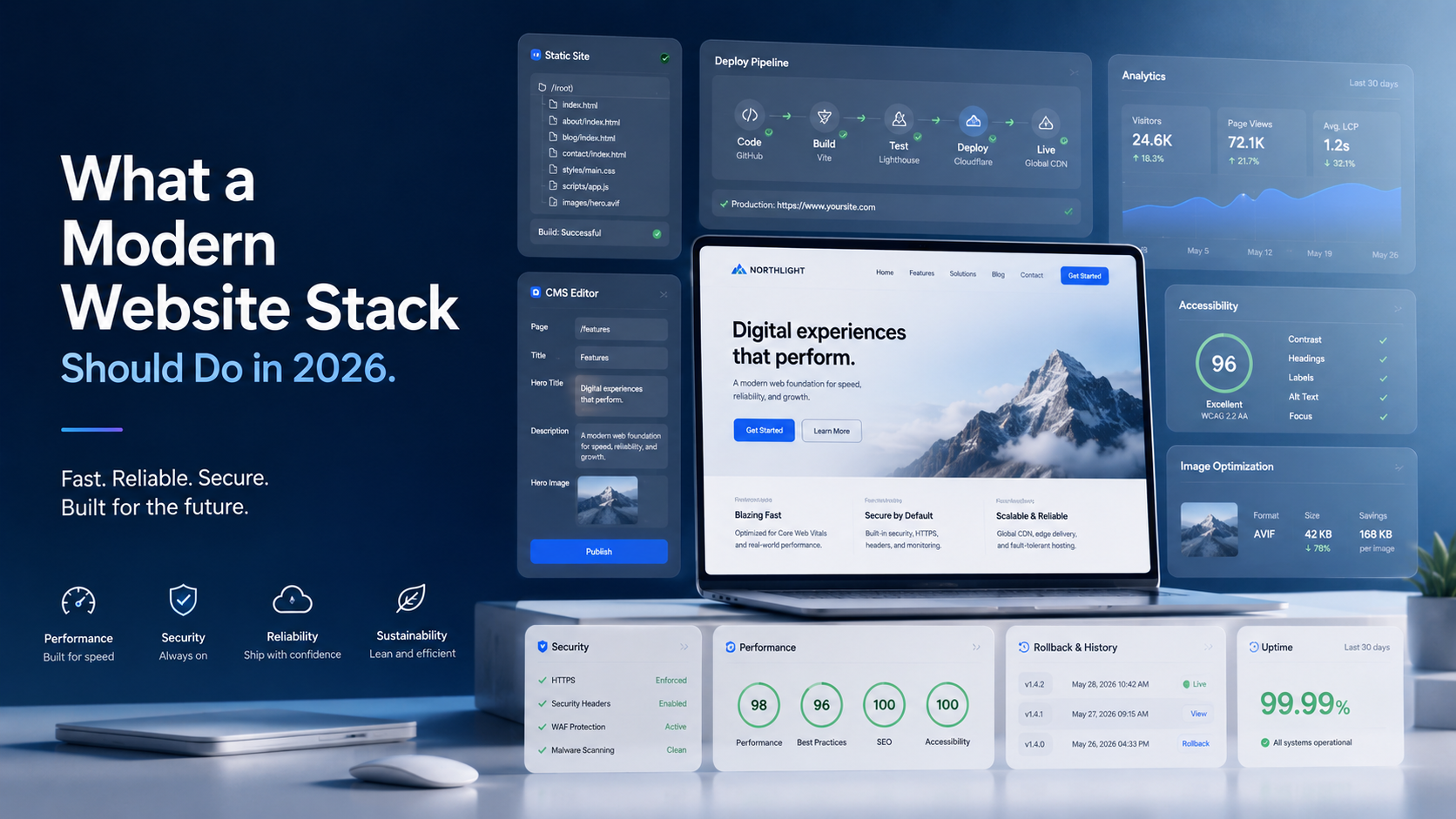
Often, though, the biggest gains come from practical improvements: serve modern image formats, compress and resize images properly, defer noncritical scripts, reduce third-party dependencies, cache aggressively, keep the page structure simple, avoid shipping unused code, and measure real user experience, not just lab scores.
That last point matters a lot.
A site can look acceptable in a synthetic tool and still feel slow in the hands of real users. Lab metrics are useful, but real-world performance is what visitors actually experience. The only speed that matters is the speed your audience feels.
Fast Does Not Mean Plain
This is where some teams overcorrect.
They hear "optimize for speed" and assume that means stripping out all personality, visual richness, and interaction until the site feels empty.
That misses the point.
A modern website can be expressive without being heavy.
The goal is not austerity. The goal is discipline.
Spend the performance budget where it creates meaning: sharp product imagery, clear typography, interaction that helps understanding, motion that explains instead of decorating, and layout choices that improve flow.
That creates a site that feels rich because it is useful, not because it loads every brand asset, animation, and script the company has ever approved.
A site should feel intentional.
That usually performs better than a site trying to feel impressive.
Speed Preserves Momentum
That is really what performance protects: momentum.
The visitor arrives with a small burst of attention and intent. Good websites respect that. They load quickly, orient the visitor fast, and help the next step happen without interruption.
Slow websites burn that momentum away.
That is why speed should be treated less like a backend concern and more like a front-line business signal.
It communicates how seriously you take the user's time.
It shapes how trustworthy the brand feels.
It influences whether interest survives long enough to become action.
My Takeaway
Website speed is a trust signal.
Performance is not just technical hygiene, and it is not only a score to improve for a dashboard. It is part of how competence is perceived online.
A fast site feels clearer, safer, and more credible.
A slow one asks the visitor for patience before it has earned it.
That is rarely a good bargain.