Why Compute Canvas Websites Are Hosted on AWS
We host on AWS because a serious website should be fast, secure, observable, recoverable, and owned by the business.
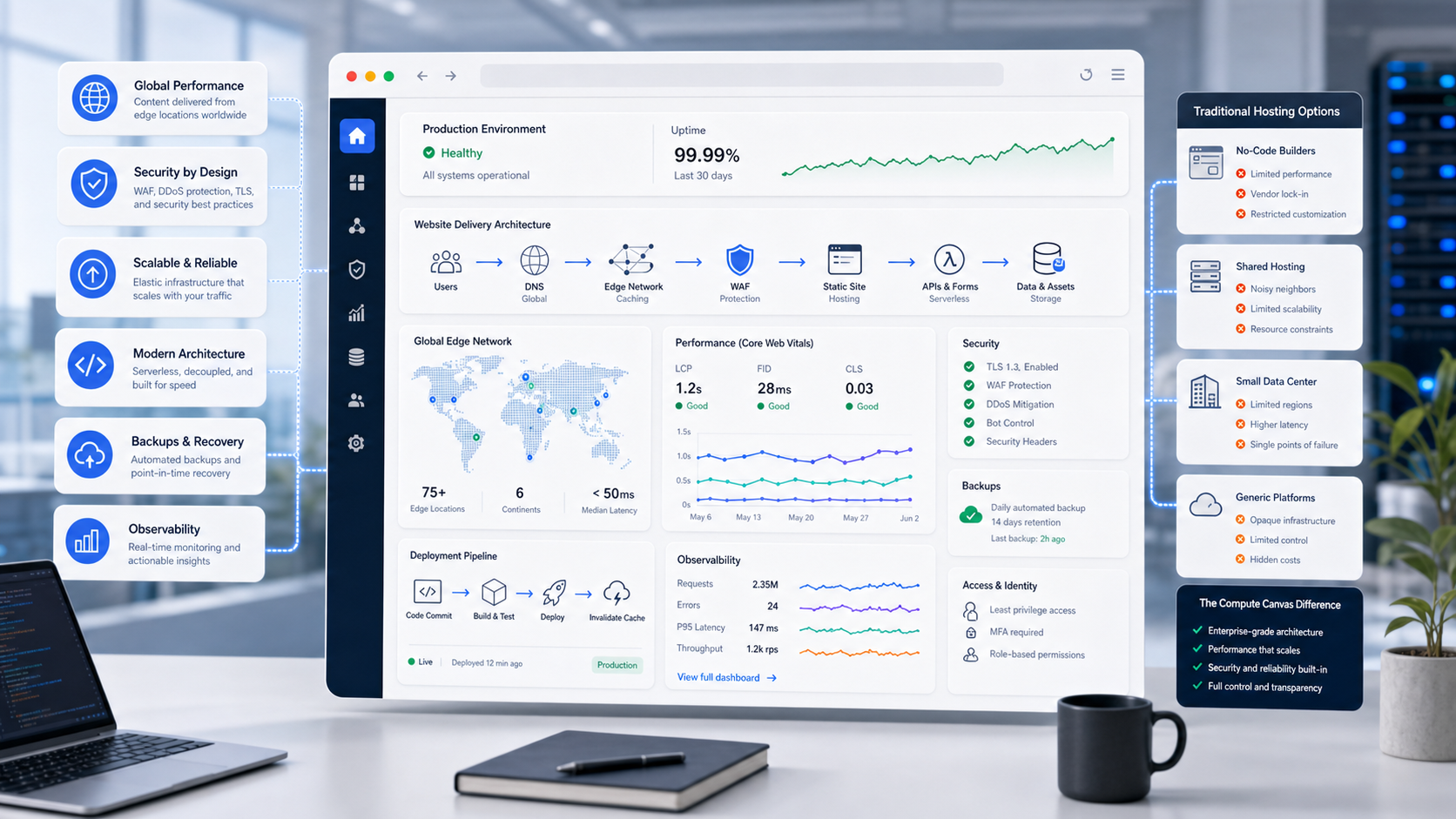
We host on AWS because a serious website should be fast, secure, observable, recoverable, and owned by the business.
A website is not just a collection of pages.
For many businesses, it is the first serious conversation with a buyer. It is the place where search traffic lands, campaigns convert, prospects evaluate trust, customers find answers, forms collect demand, and the brand either feels competent or fragile.
That is why hosting matters.
Compute Canvas websites are hosted on AWS because we want the foundation to match the responsibility the website carries. We want fast global delivery, strong security controls, clear ownership, predictable deployment, useful monitoring, durable storage, and room to grow without rebuilding the platform every time the business needs something new.
This does not mean every website on earth must use AWS.
It does mean that when we build websites for businesses that care about performance, reliability, security, and long-term control, AWS gives us a mature operating foundation that many website builders, no-code tools, small data centers, and bargain hosting providers cannot match in the same way.
Hosting Is a Business Decision
Hosting is often treated like a commodity.
Pick a platform, point the domain, upload the site, and move on. For very simple personal projects, that may be enough. For a business website, the decision deserves more attention.
Hosting affects speed, uptime, security, deployment workflow, image delivery, redirects, form handling, analytics reliability, backup strategy, incident response, cost visibility, and the team's ability to improve the site after launch.
A weak hosting foundation can make a good website feel slower and less trustworthy than it should. A strong foundation can disappear into the background, which is exactly what good infrastructure should do.
The visitor should not think about hosting.
They should simply experience a site that loads quickly, works reliably, and feels professional.
AWS Gives Us Mature Building Blocks
The value of AWS is not that every website needs every AWS service.
The value is that AWS gives us mature building blocks we can assemble deliberately: global content delivery, object storage, DNS, certificates, identity controls, logging, monitoring, serverless functions, deployment automation, backups, and security services.
For many Compute Canvas websites, the architecture can stay intentionally simple. Static or mostly static pages are served efficiently. Assets are delivered close to visitors. Lightweight backend needs, such as forms or small APIs, can be handled without maintaining a traditional server. Logs and alerts can provide operational visibility. Permissions can be scoped. Deployments can be repeatable.
That combination matters.
A business does not need complexity for its own sake. It needs a platform that can support simple architectures well and still provide a path when requirements become more serious.
Global Delivery Is Built Into the Model
Modern website visitors are not all sitting near one server.
They arrive from different regions, devices, networks, and traffic sources. A site that feels fast in the office can feel slow to a mobile visitor on a weaker connection or a buyer in another geography.
AWS gives us access to global delivery patterns through edge caching, CDN behavior, regional infrastructure, and object storage. Static assets, images, scripts, documents, and generated pages can be served in ways that reduce origin load and improve perceived speed.
This is not only a technical benefit.
Performance affects trust. A fast website feels more competent. A slow website creates doubt before the visitor evaluates the offer. For paid campaigns, slow delivery wastes attention the business already paid to earn. For organic search, performance can influence discoverability and user satisfaction.
Hosting should help preserve momentum. AWS gives us the tools to make fast delivery part of the foundation.
Security Controls Are Not an Add-On
Security is one of the biggest differences between a serious hosting foundation and a convenience-first website platform.
AWS provides mature controls around identity, access, certificates, encryption options, logging, network boundaries, web application protection, secrets management, and operational auditability. Those controls still need to be configured correctly, but they are available when the website needs them.
That matters because business websites often collect more trust than teams realize.
Contact forms, quote requests, newsletter signups, booking flows, lead magnets, customer portals, checkout flows, and analytics integrations all create security and privacy considerations. Even a marketing site can become a target for spam, abuse, credential misuse, misconfiguration, or supply-chain issues.
No hosting platform removes responsibility.
But AWS gives us a stronger control plane for operating responsibly. We can define access more carefully, monitor behavior, protect public endpoints, manage certificates, and build recovery paths without depending on a black-box builder to expose the right feature at the right time.
Ownership Matters
One of the problems with many WYSIWYG and no-code platforms is that convenience can blur ownership.
The site may be easy to edit, but the business may have limited control over hosting behavior, deployment workflow, redirects, performance tuning, server-side functionality, data handling, backups, logs, and portability. The platform owns many of the operational decisions, and the business works inside the constraints.
That tradeoff can be acceptable for some businesses.
But it should be a conscious choice.
Compute Canvas prefers an architecture where the business is not trapped by the editing surface. Content, code, assets, deployment, DNS, and hosting choices can be managed as part of a real web operating model. If the business grows, the website can grow with it. If requirements change, the architecture can adapt. If a platform no longer fits, the site is not locked inside a proprietary page builder.
Ownership is not only legal ownership of files.
It is operational control.
No-Code Platforms Optimize for Convenience
No-code and WYSIWYG platforms can be useful.
They lower the barrier to publishing. They give small teams a way to create pages quickly. They often include templates, visual editing, forms, hosting, and basic SEO settings in one package.
That convenience is real.
But convenience has limits.
As the website becomes more important, teams often run into constraints: limited performance tuning, rigid templates, difficult code control, platform-specific data models, plugin or app dependence, unclear export paths, limited observability, hidden hosting details, constrained security controls, and unpredictable behavior when the site needs custom integrations.
The issue is not that no-code tools are bad.
The issue is that they are optimized for a different problem: helping people publish without engineering. Compute Canvas is solving a different problem: building websites that can be operated, measured, secured, and improved as business infrastructure.
Observability Changes the Conversation
A mature website platform should help teams see what is happening.
Are pages fast? Are forms working? Are deployments healthy? Are errors increasing? Are assets being cached? Are visitors experiencing latency in a particular region? Did a release introduce a regression? Did a security control block suspicious traffic? Are redirects behaving correctly?
AWS gives us access to real observability primitives: logs, metrics, alarms, traces, CDN analytics, function monitoring, storage events, deployment outputs, and security signals. We do not need every signal on every project, but the capability exists when it matters.
This is a major difference from platforms that hide the operational layer.
If the website underperforms, a team should not be limited to guessing. It should be able to inspect the delivery path, measure behavior, identify weak points, and improve the system.
A website that can be observed can be operated.
AWS Supports a Static-First Philosophy
Many business websites do not need to behave like heavy applications.
Service pages, landing pages, case studies, articles, pricing pages, documentation, and contact pages often benefit from static-first architecture: fast HTML, optimized assets, minimal browser JavaScript, CDN caching, and small interactive pieces only where they create value.
AWS is a strong fit for this model.
Static assets can be durable and cacheable. CDN behavior can reduce latency. Serverless functions can handle forms or lightweight backend logic. Deployment pipelines can publish predictable builds. Security controls can protect the public surface. Monitoring can validate important paths.
The result is not overengineering.
It is restraint. Use static delivery where static delivery is best. Add dynamic behavior where dynamic behavior creates value. Avoid shipping an unnecessarily heavy runtime to visitors who simply want to read, evaluate, and act.
Cost Discipline Still Matters
AWS is powerful, but it is not automatically cheaper.
Cloud platforms make it easy to create resources, and that convenience can create waste. Poor caching, oversized services, unnecessary logs, unoptimized images, excessive data transfer, forgotten environments, and overcomplicated architectures can all increase cost.
That is why Compute Canvas favors simple, understandable architectures.
For a typical business website, the goal is not to use the most services. The goal is to use the right services. Static-first delivery, edge caching, optimized images, scoped functions, clear storage, cost alerts, and documented ownership can keep the architecture lean.
Cloud cost discipline is part of professional implementation.
The benefit of AWS is control and capability. The responsibility is to design with limits.
The Real Comparison Is Operating Model
The difference between AWS and many website platforms is not only the feature list.
It is the operating model.
A WYSIWYG platform asks, 'How quickly can someone build a page visually?'
A bargain host asks, 'How cheaply can we put files on a server?'
A small provider may ask, 'Can we make this simple enough for most customers?'
A cloud architecture asks, 'How should this digital system be delivered, protected, observed, recovered, and improved?'
Those are different questions.
Compute Canvas websites are built for businesses that want more than a page builder. They want a professional website foundation that supports speed, credibility, security, publishing, and growth.
When a Simpler Platform May Be Enough
There are cases where a no-code or hosted website builder is enough.
A temporary landing page. A hobby project. A very small local presence. An internal prototype. A business that values DIY editing above every other concern. A site with no custom performance, security, integration, or ownership requirements.
Those are valid use cases.
Professional judgment means choosing the right tool for the job, not pretending one architecture is always best.
For Compute Canvas, the question is usually different: will this website need to support trust, search, content growth, form handling, analytics, performance, security, and future change? If the answer is yes, AWS becomes a stronger foundation because it gives us control over the pieces that matter.
What Clients Actually Experience
Most clients do not need to think about AWS day to day.
That is the point.
They experience the benefits indirectly: faster pages, cleaner deployment, fewer platform constraints, better recovery options, stronger security posture, reliable forms, clearer ownership, scalable architecture, and a site that can evolve without being rebuilt from scratch.
Visitors experience those benefits even more quietly.
The site loads. The page is stable. The form works. The content is available. The experience feels professional. The business feels prepared.
Good infrastructure is often invisible.
But invisible does not mean unimportant.
Final Thought
Compute Canvas websites are hosted on AWS because we believe a business website should be treated as real digital infrastructure.
That does not mean every site needs a complicated cloud architecture.
It means the foundation should support professional expectations: global delivery, security, observability, repeatable deployment, recoverability, ownership, and room to grow.
WYSIWYG platforms and no-code builders can be useful. Shared hosting and smaller providers can serve pages. But when the website is part of how the business earns trust, captures demand, supports campaigns, and communicates expertise, the hosting foundation matters.
AWS gives us the control and maturity to build websites that are not only attractive, but operationally sound.
That is the difference we care about.
Not cloud complexity for its own sake.
Cloud discipline in service of a better website.