Content Strategy Should Start Before Design
A website layout is only as strong as the story it is organizing.
A website layout is only as strong as the story it is organizing.
A website layout is only as strong as the story it is organizing.
That is why the smartest redesigns start with content strategy, not visual design.
It is tempting to begin a website project with the parts people can see: homepage mockups, color palettes, typography, animation, section layouts, and component libraries. Those decisions matter. Good design shapes perception, builds confidence, and helps visitors move through a page.
But design works best when it has something clear to organize.
If the message is vague, the layout has to work too hard. If the offer is unclear, the visuals can only disguise the problem for a moment. If the proof is weak, no amount of polish can make the business feel truly credible. If the visitor does not understand what to do next, even the most beautiful page can fail.
Content strategy creates the map.
It defines who the website is speaking to, what the business needs to say, what the visitor needs to believe, what objections must be addressed, what proof is required, and what action should come next.
Without that map, design becomes decoration.
With it, design becomes direction.
Design Cannot Rescue Vague Positioning
A website can look impressive and still fail.
That happens when the design is strong but the positioning is weak.
The homepage may have a bold hero section, elegant typography, polished imagery, and smooth scrolling effects. But if the headline does not explain what the business does, who it helps, and why it matters, visitors are left guessing.
And guessing is expensive.
A visitor who has to work too hard to understand the offer may not stay long enough to appreciate the design. They may not click into the service pages. They may not reach the contact form. They may simply leave and choose a competitor that communicates more clearly.
Visual polish can create a first impression.
Clarity creates momentum.
Before a redesign moves into layout, a business needs to answer a few foundational questions: what do we do, who is this for, what problem are we solving, why does that problem matter now, what makes our approach credible, what proof supports our claims, and what should the visitor do next?
These questions are not just copywriting prompts. They are design inputs.
A clear message helps determine what belongs above the fold, what should be emphasized, what can be removed, what proof needs to appear early, and how the page should guide the visitor.
Content Strategy Creates the Map
Content strategy is not just "writing the words."
It is the planning system behind the website's communication.
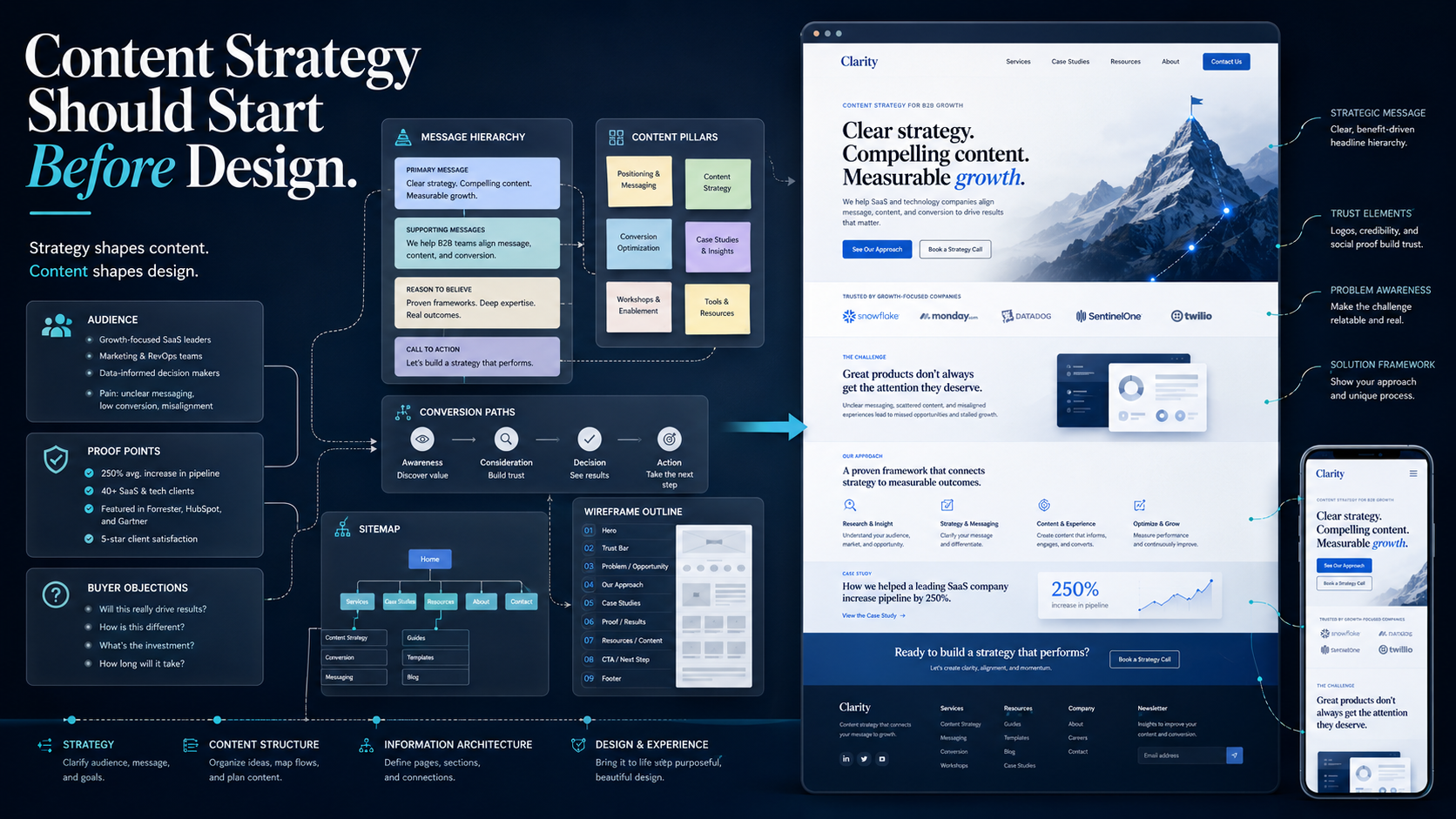
It defines the audience, message hierarchy, content priorities, buyer objections, proof points, page goals, and conversion paths. It helps the team decide not only what to say, but when and where to say it.
A strong content strategy answers questions like: who are the primary visitors, what are they trying to understand, what do they already believe, what are they skeptical about, what information do they need before taking action, which pages support awareness, evaluation, decision, and conversion, what proof is needed at each stage, what content can support search visibility, what content can support sales conversations, and what should be omitted because it creates noise?
This is where the website begins to take shape.
Not visually yet, but strategically.
The team starts to understand the role of each page. The homepage does not need to say everything. The service page does not need to behave like a brochure. The pricing page does not need to answer every edge case. The contact page does not need to be a dead end.
Each page has a job.
Content strategy defines that job before design tries to solve it.
The Best Wireframes Are Editorial
Wireframes are often treated as layout exercises.
Where does the hero go? How many columns should this section have? Should this be a card grid or a split layout? Where should the button sit? How many testimonials should we show?
Those are useful questions, but they should not come first.
Before choosing components, decide the argument each page needs to make.
A homepage may need to orient, qualify, prove, and route. It should quickly help visitors understand what the company does, whether it is relevant to them, why it is credible, and where they should go next.
A service page may need to explain outcomes, process, scope, fit, and proof. It should help a visitor understand the problem being solved, what the service includes, what working together looks like, and why the provider can be trusted.
A pricing page may need to reduce anxiety. It should explain cost ranges, pricing factors, engagement models, what is included, and how to think about value.
A case study may need to show transformation. It should explain the client's situation, the challenge, the approach, the outcome, and what made the work meaningful.
A contact page may need to lower friction. It should explain what happens after someone reaches out, who responds, how quickly they respond, and what the first conversation involves.
These are editorial decisions.
Once they are clear, wireframes become much stronger. The design is no longer arranging random blocks. It is organizing a persuasive sequence.
Every Page Needs a Content Job
One of the most useful questions in a redesign is simple:
What job does this page do?
Not every page should do the same thing.
Some pages educate. Some qualify. Some persuade. Some route. Some reassure. Some convert. Some support existing customers. Some help search visitors discover the business. Some help sales teams answer common questions.
When a page has no clear job, it usually becomes a collection of sections.
A hero. A few cards. A statement. A testimonial. A CTA.
It may look like a website, but it does not create movement.
A content-first approach prevents that. It forces the team to define the purpose of the page before designing it.
For example, a service page for cloud migration should not simply say, "We offer cloud migration services." It should answer the buyer's real questions: what kind of migration, for what type of organization, what risks do you manage, what does the process look like, how do you reduce downtime, what cloud platforms do you support, what happens after migration, and how do we know you have done this before?
Those questions shape the page structure.
The content job creates the design brief.
Message Hierarchy Comes Before Visual Hierarchy
Designers often talk about visual hierarchy: what the visitor sees first, what receives emphasis, and how the eye moves through the page.
But visual hierarchy depends on message hierarchy.
Before deciding what should be largest, brightest, or most prominent, the team needs to decide what matters most.
Is the most important message the company's category? The audience it serves? The problem it solves? The outcome it creates? The proof behind the claim? The urgency of the problem? The next step?
If the message hierarchy is unclear, visual hierarchy becomes guesswork.
This is why content strategy should happen before high-fidelity design. It gives design a clear set of priorities.
The primary headline can focus on the strongest promise. The subhead can clarify audience and outcome. The first proof point can reduce skepticism. The service sections can mirror buyer priorities. The calls to action can match intent. The FAQ can answer objections at the right moment.
Good design makes important things visible.
Content strategy decides what is important.
Content Strategy Helps Teams Say No
One of the most valuable parts of content strategy is subtraction.
Website projects often collect too much.
Too many stakeholder requests. Too many internal priorities. Too many features. Too many services. Too many proof points. Too many calls to action. Too many words that do not help the visitor.
Without a strategy, everything feels important.
With a strategy, the team can make sharper decisions.
Does this section help the visitor understand, trust, or act? Does this paragraph answer a real question? Does this page support a business goal? Does this CTA match the visitor's stage of intent? Does this proof belong here or somewhere else? Is this content for the buyer, or is it internal self-description?
A strong website is not created by saying everything.
It is created by saying the right things in the right order.
That requires editorial discipline.
Strong Content Makes Design Easier
When content strategy is weak, design teams are often forced to compensate.
They create visual interest because the message lacks focus. They add sections because the page does not have a clear argument. They use abstract imagery because the business has not provided concrete examples. They overuse animation because the content does not create enough momentum.
That is not a design failure.
It is a strategy problem showing up visually.
When the content strategy is strong, design becomes more purposeful.
The designer knows which claim needs emphasis. The proof has enough substance to become a compelling section. The CTA has context. The page flow has logic. The layout supports the buyer journey. The visual system reinforces the story instead of inventing one.
This creates a better working relationship between content and design.
Words define the argument.
Design shapes the experience of that argument.
Neither should work in isolation.
Content Is Business Infrastructure
Strong website content does not stop working after launch.
It becomes part of the business infrastructure.
A clear service page can support sales conversations. A thoughtful FAQ can reduce repetitive questions. A strong case study can help close deals. A comparison page can help buyers evaluate options. A pricing explanation can reduce poor-fit leads. A technical article can support search visibility. A careers page can improve recruiting. A customer education page can support onboarding. A clear process page can set expectations before a project begins.
This is why content strategy deserves serious attention.
The words on a website are not filler around the design. They are assets the business can reuse across marketing, sales, support, recruiting, and customer success.
A good website does not only attract visitors.
It helps the organization communicate more clearly.
SEO Also Starts With Content Strategy
Search visibility is another reason content should come before design.
Too often, SEO is treated as something to apply at the end of a website project: add metadata, adjust headings, compress images, submit the sitemap, and move on.
That is not enough.
Search performance depends heavily on whether the website has useful pages that match real search intent.
Content strategy helps identify what buyers are searching for, which topics deserve dedicated pages, which service pages need more depth, which comparison terms matter, which questions should become FAQs or articles, which pages need structured headings, which internal links should connect related ideas, and which content can demonstrate expertise.
Design can make SEO content easier to read and navigate, but it cannot replace the need for useful substance.
A beautiful page with thin content will struggle to perform.
A content-first redesign gives search visibility a stronger foundation.
Content Strategy Reduces Redesign Risk
Website redesigns can go wrong when teams focus too much on the new look and not enough on the communication system underneath.
A company may launch a beautiful new site and then discover that important pages were removed, search traffic dropped, sales cannot find the information they used to send prospects, or visitors are confused by new language.
Content strategy helps reduce that risk.
Before design begins, the team can audit existing content, identify what works, preserve valuable pages, consolidate weak pages, plan redirects, map buyer journeys, and decide what new content is needed.
This creates a smarter redesign process.
Instead of simply replacing the old site with a prettier version, the team improves the site's structure, message, and usefulness.
That is a better investment.
What a Content-First Website Process Looks Like
A content-first process does not mean every word must be final before design begins.
It means the strategic content decisions happen early enough to shape the design.
A practical process might look like this:
Discovery: understand the business, audience, services, sales process, goals, and current website performance.
Content audit: review existing pages, search visibility, analytics, sales materials, FAQs, and proof assets.
Messaging strategy: define positioning, audience segments, key messages, objections, proof points, and voice.
Sitemap and page roles: decide which pages are needed and what job each page should do.
Page briefs: create structured briefs for key pages, including audience, goal, message hierarchy, proof, CTA, and SEO considerations.
Editorial wireframes: map the sequence of ideas before committing to visual design.
Design exploration: create layouts that support the content strategy and brand experience.
Copy refinement: write and edit page content in context with the design.
Build and QA: implement the pages, test usability, accessibility, performance, SEO, and analytics.
Post-launch improvement: use real data and feedback to revise content over time.
This process keeps design and content connected.
It prevents the common problem of designing beautiful containers before knowing what they need to contain.
The Homepage Is Not a Brochure Cover
The homepage is often where content strategy matters most.
Many businesses treat the homepage like a brochure cover: a big statement, a few service boxes, some logos, and a contact button.
A stronger homepage acts more like a strategic router.
It helps different visitors find the right path while building enough confidence for them to continue.
A good homepage may need to orient visitors quickly, clarify the offer, identify who the company serves, highlight the main services or solutions, show proof, express the brand's point of view, address common doubts, route visitors to deeper pages, and invite the next step.
That is a lot of work.
Without content strategy, the homepage can become either too vague or too crowded.
With content strategy, each section has a reason to exist.
Service Pages Need More Than Service Lists
Service pages are another place where content-first thinking makes a major difference.
Many service pages simply list capabilities.
That is rarely enough.
A strong service page should explain why the service matters, what problems it solves, what outcomes it supports, what the process looks like, what is included, who it is best for, and what proof supports the claim.
For example, a web design service page should not only say that the company offers design, development, SEO, and hosting.
It should explain what kind of businesses the service is for, what problems trigger a redesign, how the process works, what deliverables are included, how content and design are handled, what technology choices are available, how performance and accessibility are considered, how success is measured, and what happens after launch.
That content gives the page substance.
Design can then turn that substance into a clear, persuasive experience.
The Contact Page Is Content Too
The contact page is often treated as an afterthought.
A form. A phone number. An email address. Maybe a short sentence.
But for many service businesses, the contact page is where the visitor decides whether taking action feels safe.
Content strategy can improve this page dramatically.
Instead of simply saying "Contact us," the page can explain who should reach out, what kinds of projects are a good fit, what information to include, how quickly the team responds, who will reply, what happens during the first conversation, whether there is a cost for the initial consultation, and what happens if the company is not the right fit.
This content reduces friction.
It turns the contact page from a form into an invitation with expectations.
That can improve both conversion rate and lead quality.
The Best Redesigns Start With Words, Not Wireframes
This does not mean design is secondary.
It means design is stronger when it is informed.
Words reveal the strategy. Wireframes organize the strategy. Visual design brings the strategy to life. Development makes the strategy usable. Analytics helps improve the strategy after launch.
When the order is reversed, teams often create beautiful pages that later need to be filled with meaning. That is backwards.
A website should not be designed and then "populated" with content.
It should be shaped around the story it needs to tell.
The smartest redesigns start with words because words expose whether the strategy is clear.
If the team cannot explain the offer in plain language, the design process should not hide that problem. It should surface it early, when it is still possible to fix.
Final Thought
Content strategy should start before design because a website is not just a collection of screens.
It is a guided argument.
It tells visitors where they are, why the business matters, what problems it solves, how it can help, why it can be trusted, and what should happen next.
Design makes that argument visible, memorable, and usable.
But design cannot invent the argument by itself.
A strong layout needs a strong story.
A strong story needs clear positioning.
Clear positioning needs strategy before pixels.
That is why the smartest website projects begin with content.
Not because words matter more than design.
Because words give design something worth organizing.