What a Modern Website Stack Should Do in 2026
The stack matters when it makes the site faster to ship, safer to change, and easier to grow.
The stack matters when it makes the site faster to ship, safer to change, and easier to grow.
That sounds simple, but it is easy to forget.
Website technology conversations often drift toward the fashionable: the newest framework, the loudest conference demo, the tool that promises to replace five other tools, or the architecture everyone seems to be debating on developer social media.
But a modern website stack should not exist to impress other engineers.
It should help the business publish faster, perform better, change safely, and learn from what visitors actually do.
In 2026, the best website stack is not necessarily the most complex one. It is the one that gives your team confidence.
The Modern Stack Is Boring in the Best Way
Great website technology should disappear into the workflow.
Designers should see changes quickly. Developers should have clear components, predictable builds, and reliable deployments. Editors should not need engineering help every time they want to adjust a headline, publish an article, update a case study, or change a call to action.
That is the quiet power of a good stack. It removes friction from the people doing the work.
For many organizations, the website is no longer a one-time project. It is a living system. Marketing needs landing pages. Sales needs better proof. Recruiting needs updated culture content. Support needs clearer documentation. Leadership wants analytics. Security wants fewer risks. Developers want maintainability.
A modern stack has to serve all of those needs without becoming fragile.
Frameworks such as Astro, Next.js, React Router Framework Mode, and Vite-powered React all solve different parts of this problem. Astro's islands architecture focuses on rendering most of a page as fast static HTML while adding smaller JavaScript islands only where interactivity is needed. Next.js provides a full React application framework with features such as the App Router, Server Components, Suspense, and Server Functions. React Router has evolved beyond simple client-side routing, with framework capabilities such as server rendering, pre-rendering, streaming, and type generation. Vite continues to be a popular foundation for fast frontend development because of its lean dev server and fast hot module replacement workflow.
The right choice depends on the job.
A content-heavy marketing site does not have the same needs as a logged-in SaaS dashboard. A small consulting firm does not have the same publishing workflow as a global enterprise. A site updated twice a month does not need the same content operations as one publishing several times a day.
The stack should follow the operating model.
Static First, Interactive Where It Matters
Most marketing websites do not need to ship a large JavaScript application to every visitor.
That is one of the most important ideas in modern web architecture.
A visitor reading a service page, blog article, case study, pricing explanation, or documentation page usually needs fast content, clear structure, accessible navigation, and a simple path to action. They do not need a heavy app runtime just to read text and click a button.
Static HTML, partial hydration, and content-driven builds can make sites faster, more resilient, and easier to cache. They also reduce the amount of code that must run in the browser, which can improve the experience for visitors on slower devices or weaker connections.
This is why Astro has become attractive for content-heavy websites. Its model treats HTML as the default and lets teams add interactivity deliberately rather than automatically. Astro describes this as rendering the majority of the page as static HTML while adding JavaScript only for interactive islands such as carousels, menus, forms, calculators, or personalized widgets.
That does not mean every site should use Astro.
It means every team should ask a better question: where does interactivity actually create value?
A pricing calculator may need JavaScript. A product configurator may need JavaScript. A search experience may need JavaScript. A dashboard definitely needs JavaScript.
But a plain service page probably does not need to behave like a full application.
The modern pattern is not no JavaScript. It is intentional JavaScript.
Performance Is a Business Feature
Performance is often discussed as an engineering concern, but it is also a business concern.
A slow website creates doubt before a visitor reads a word. It weakens trust, hurts the user experience, and can reduce the effectiveness of every marketing dollar spent driving traffic to the site.
In 2026, performance should not be treated as a final optimization pass. It should be designed into the stack from the beginning.
That means asking practical questions: can pages be statically generated? Can images be optimized automatically? Can unnecessary JavaScript be avoided? Can pages be cached close to the visitor? Can the team measure performance before and after deployment? Can regressions be caught before they reach production?
Next.js, for example, includes an image component designed to serve correctly sized images, support modern formats such as WebP, reduce layout shift, and lazy-load images when appropriate. Those features matter because image weight remains one of the easiest ways for otherwise well-built websites to become slow.
But the larger lesson applies across frameworks: your stack should make the right performance choice the easy choice.
If every image, script, and component requires manual discipline, performance will eventually decay. A better stack builds guardrails into the workflow.
Content Operations Matter as Much as Code
A website stack is not just a developer decision.
It is also a publishing decision.
A technically elegant site can still fail if the content workflow is painful. If every small update requires a developer ticket, the site becomes stale. If preview links are unreliable, stakeholders lose confidence. If content models are too rigid, editors work around the system. If publishing is risky, teams publish less often.
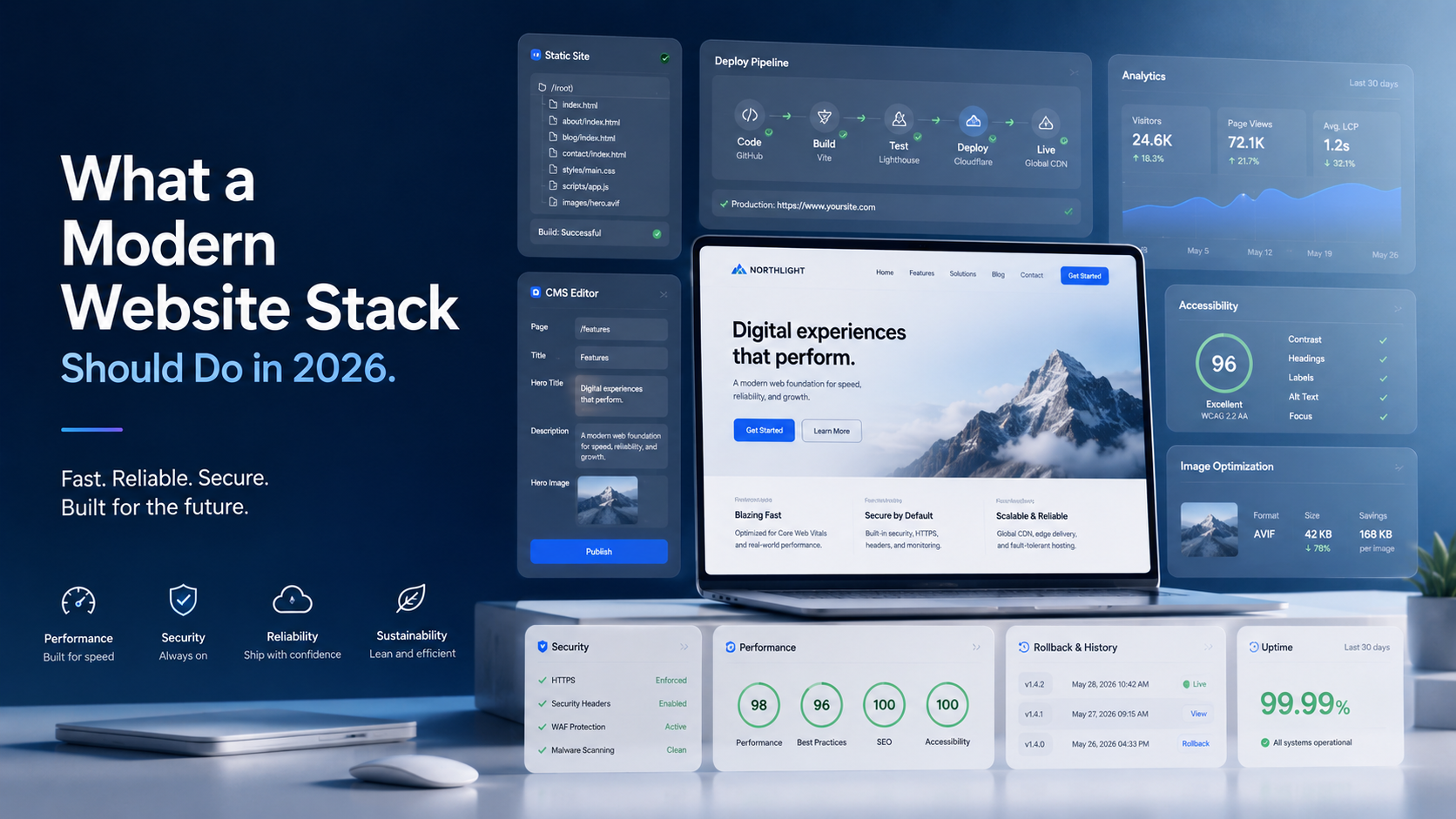
A modern website stack should support the full content lifecycle: drafting, previewing, reviewing, approving, publishing, measuring, revising, and rolling back when needed.
This is where the CMS, component model, design system, deployment platform, and analytics all come together.
For a small site, markdown or MDX in a Git-based workflow may be enough. For a larger organization, a headless CMS may be necessary so non-technical teams can manage content safely. For enterprise environments, governance, localization, permissions, compliance, and audit trails may become just as important as rendering speed.
The point is not that every business needs the same stack.
The point is that content operations should be part of the stack conversation from day one.
Choose for Operations, Not Novelty
A stack is successful when the business can publish, test, measure, and revise without drama.
That means the framework is only one part of the decision.
Version control matters. Preview deployments matter. Analytics matter. Forms matter. Accessibility checks matter. Image optimization matters. Security updates matter. Rollback paths matter. Documentation matters. Developer onboarding matters.
A trendy stack that only one person understands is a liability. A slightly less exciting stack that the whole team can maintain is often the smarter investment.
This is especially true in a world where frameworks continue to evolve quickly. React Router's newer framework capabilities, for example, reflect how routing, server rendering, streaming, and type safety are becoming more integrated into modern React workflows. Next.js continues to evolve its App Router and server-first architecture, while also requiring teams to stay current with security updates and platform changes. In May 2026, Vercel announced a coordinated Next.js security release addressing multiple advisories, which is a useful reminder that framework choice is also an operational commitment.
The best technology decision is rarely the one that looks most impressive in a demo.
It is the one your team can keep improving.
The Stack Should Make Change Safer
A modern website should be easy to change, but not reckless to change.
That balance is important.
Marketing teams need speed. Engineering teams need stability. Business leaders need confidence that updates will not break lead generation, search visibility, analytics, or compliance.
A good stack creates safety through process and tooling.
Preview deployments let stakeholders review work before it goes live. Component libraries keep layouts consistent. Type checking catches mistakes earlier. Automated tests protect important flows. Accessibility checks reduce risk. Analytics validation ensures campaigns are measured correctly. Rollbacks provide a recovery path when something goes wrong.
This is where boring becomes valuable.
The more predictable the workflow, the more often teams can improve the site.
And the more often teams improve the site, the more valuable the site becomes.
Match the Stack to the Site
There is no universal best stack. There are better and worse matches.
For a content-heavy marketing site, Astro can be a strong fit because it starts with static HTML and adds interactivity only where needed.
For a complex React application with dynamic routes, server-side logic, image optimization, and deep platform support, Next.js may be the better choice. Its App Router uses React features such as Server Components, Suspense, and Server Functions.
For teams already invested in React Router or Remix-style data patterns, React Router Framework Mode may offer a practical path forward, especially as React Router has added server rendering, pre-rendering, streaming, and type safety features.
For custom frontend applications where the team wants speed, flexibility, and a lean development experience, Vite-powered React remains a strong foundation. Vite's own documentation emphasizes a fast dev server, native ES module support, and fast hot module replacement.
The mistake is not choosing one of these tools.
The mistake is choosing without understanding the business workflow behind the website.
A Practical 2026 Website Stack Checklist
Before committing to a stack, ask what the site needs to do after launch.
Can non-developers publish safely? Can developers ship without fear? Can pages be fast by default? Can the team preview every meaningful change? Can the site scale from five pages to five hundred? Can analytics show what is working? Can forms integrate with the business process? Can accessibility be checked regularly? Can images and media be managed cleanly? Can security updates be applied without panic? Can the team roll back quickly? Can new developers understand the project within a reasonable time?
These questions are less exciting than framework debates, but they are more important.
The real value of a modern stack is not the architecture diagram. It is the operating rhythm it enables.
The Best Stack Helps the Team Learn
A modern website is never truly finished.
Search behavior changes. Buyer expectations change. Products change. Competitors change. The business changes.
The stack should make learning easier.
That means pages should be measurable. Experiments should be possible. Content should be revisable. Landing pages should be easy to launch. Technical performance should be monitored. Search visibility should be tracked. Calls to action should be tested. The team should be able to look at evidence and make improvements without rebuilding the entire site.
A good stack turns the website into a system of continuous improvement.
A bad stack turns every improvement into a negotiation.
Final Thought
A modern website stack in 2026 should not be judged by how fashionable it is.
It should be judged by what it makes easier.
Does it make the site faster? Does it make publishing safer? Does it make changes less risky? Does it help the team learn? Does it reduce operational friction? Does it support the business as it grows?
The stack matters when it helps the organization move with more confidence.
The best website technology is not the one that calls the most attention to itself.
It is the one that quietly helps the whole team build, publish, measure, and improve.
Boring, in the best way.