Why Public Cloud Hosting Changed the Website Playbook
Cloud platforms made reliability, scale, and global delivery accessible to teams that once needed large infrastructure budgets.
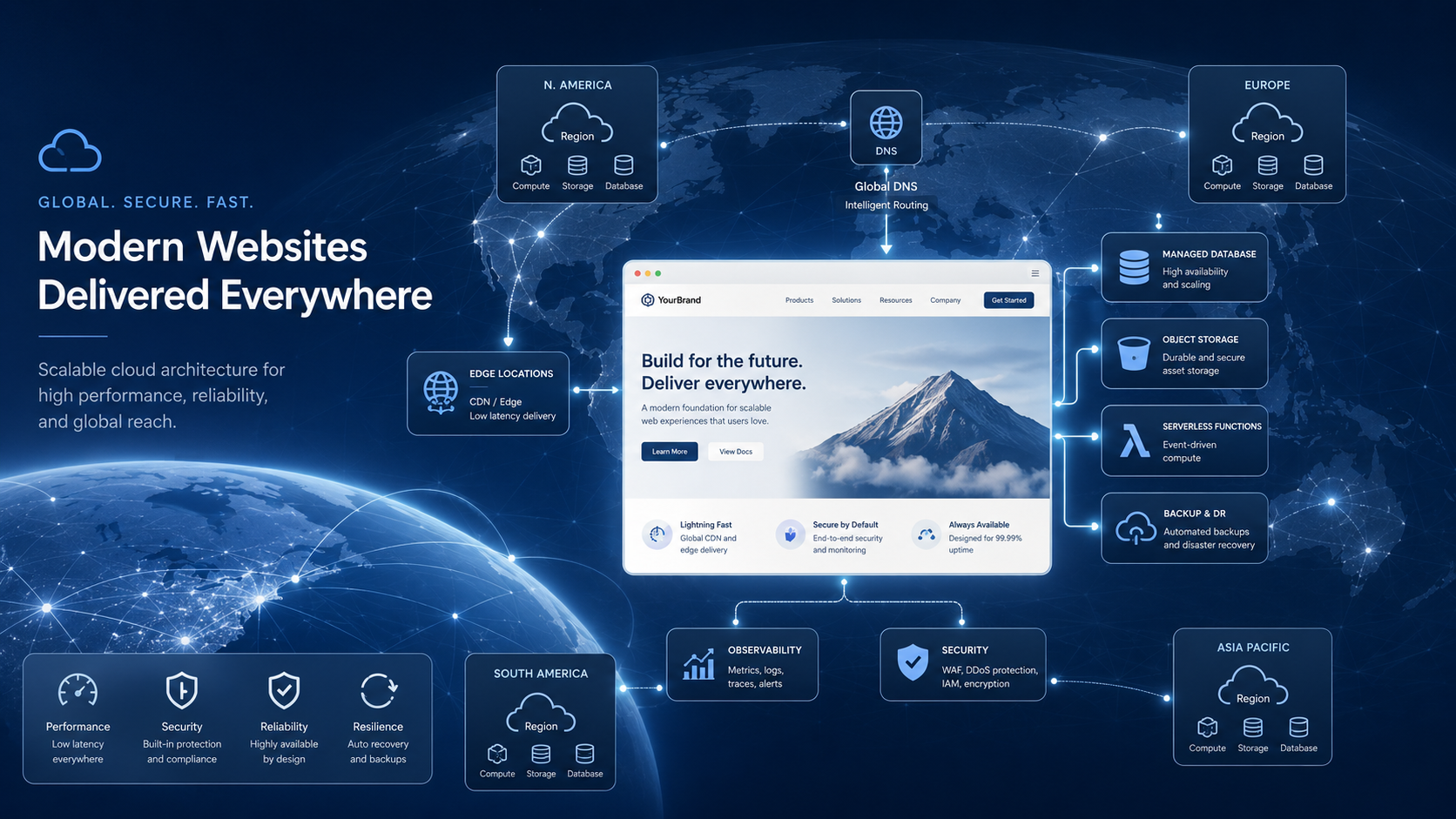
Cloud platforms made reliability, scale, and global delivery accessible to teams that once needed large infrastructure budgets.
That shift changed what businesses could expect from a website.
Not long ago, many business websites were hosted on a single shared server or a small virtual machine. The setup was simple, but it came with familiar risks. A traffic spike could slow the site down. A database issue could take pages offline. A failed machine could turn a normal business day into an emergency. Backups were often inconsistent. Security depended heavily on manual patching. Performance was usually tied to one region, one server, or one hosting provider's limitations.
Public cloud hosting changed that baseline.
It did not make infrastructure magically simple, and it certainly did not remove the need for good judgment. But it gave ordinary teams access to capabilities that were once reserved for large enterprises: managed storage, global content delivery, serverless functions, managed databases, automated backups, regional redundancy, observability, identity controls, and elastic capacity.
For website teams, that changed the playbook.
The question became less about where do we put the server and more about how do we build a reliable digital platform that can keep improving.
From Single Servers to Managed Platforms
The early website hosting model was easy to understand: files, a database, a web server, and a control panel.
For small sites, that was often enough. But as websites became more important to sales, marketing, support, recruiting, and customer experience, the weaknesses of that model became harder to ignore.
A single-server website concentrates too much risk in one place. If the server slows down, the website slows down. If the database is overloaded, the user experience suffers. If the machine fails, the site may disappear. If the backup process is weak, recovery becomes uncertain.
Large public clouds changed the default expectations.
Today, a modern website can use object storage for media, a CDN for global delivery, managed databases for persistence, serverless functions for lightweight backend logic, and observability tools for monitoring. Cloud CDN platforms are designed to serve content closer to users, reducing latency and backend load; Google Cloud describes Cloud CDN as using Google's global edge network to bring content closer to visitors, while Azure Front Door is positioned as a global content delivery and application acceleration service using Microsoft's edge network.
That matters because websites are no longer just pages. They are business systems.
They collect leads. Publish content. Support campaigns. Host product information. Feed analytics. Integrate with CRMs. Serve customers across regions. Protect brand credibility.
Hosting had to evolve because the role of the website evolved.
The Real Value Is Operational Leverage
The biggest benefit of public cloud hosting is not that it gives teams more infrastructure.
It is that it reduces the amount of infrastructure work teams should not have to do themselves.
That is operational leverage.
A team can use managed databases instead of patching and maintaining database servers. It can use object storage instead of building custom file storage. It can use a CDN instead of serving every visitor from one origin. It can use managed identity and access controls instead of inventing its own permission model. It can use logs, metrics, and alerts instead of guessing what went wrong after users complain.
This frees teams to focus on the work that actually differentiates the business.
For a marketing site, that means better content, stronger messaging, faster landing pages, cleaner analytics, clearer conversion paths, and more reliable campaign launches.
For an e-commerce site, it means speed, uptime, checkout reliability, inventory integration, and resilience during spikes.
For a SaaS company, it means documentation, onboarding, product education, account flows, and customer trust.
The public cloud is valuable when it lets the team spend less energy maintaining plumbing and more energy improving the customer experience.
Global Delivery Became Normal
One of the most important changes public cloud hosting brought to websites is global delivery.
In the old model, a website often lived in one physical location. Visitors near that server had a better experience than visitors far away. That could create meaningful performance differences for businesses serving regional, national, or international audiences.
Cloud and edge platforms changed expectations. Cloudflare says its global network spans hundreds of cities in more than 100 countries, while Azure Front Door documentation lists 192 edge locations across 109 metro cities as of its current documentation.
For website owners, the important idea is not the exact number of locations. It is the shift in architecture.
Static assets, images, scripts, documents, and even some dynamic experiences can be delivered from locations closer to users. This can improve page speed, reduce origin load, and make websites more resilient during traffic spikes.
That is especially important because performance is not only a technical metric. It shapes trust.
A fast website feels more professional. A slow website creates doubt. Visitors may not know whether the issue is hosting, code, images, or the network. They only know the experience is frustrating.
Cloud hosting gave more teams a practical way to make fast delivery part of the foundation.
Public Cloud Made Launches Less Fragile
A website launch used to carry a particular kind of anxiety.
Would the server handle traffic? Would the DNS change work? Would the database survive the campaign? Would backups be current? Would anyone know what failed if the site went down?
Modern cloud platforms do not eliminate launch risk, but they provide better tools to manage it.
Teams can create preview environments before publishing. They can deploy through pipelines instead of manually uploading files. They can roll back when something breaks. They can monitor traffic, errors, latency, and resource usage. They can separate static content from dynamic services. They can cache aggressively where appropriate. They can scale specific parts of the architecture instead of overbuilding everything.
That changes the rhythm of website work.
Instead of treating a launch as a one-time high-risk event, teams can treat the website as a living system. Publish, measure, revise, and improve.
This is where cloud hosting supports more than uptime. It supports better operations.
Cloud Is Not Automatically Cheaper
Public cloud hosting can reduce waste, but it can also create new forms of waste.
That is one of the most important lessons for 2026.
Cloud platforms make it easy to provision resources. That convenience is powerful, but it can also lead to surprise bills if teams do not understand traffic patterns, storage growth, logging volume, data transfer costs, build minutes, image transformations, database sizing, or cache behavior.
Poor caching can send unnecessary traffic back to the origin. Oversized services can sit underused. Noisy logs can become expensive. Unoptimized images can increase bandwidth. Complex architectures can multiply small costs across multiple services.
The result is a paradox: cloud can be more efficient than traditional hosting, but only when it is designed with limits.
A good website architecture should have clear cost boundaries. It should be obvious what scales, what is cached, what is monitored, and what happens when traffic increases.
Cloud cost discipline is not about being cheap. It is about avoiding accidental complexity.
Cloud Is Not Automatically Simpler
Another common misunderstanding is that public cloud makes everything easier.
It can, but only if the architecture is designed carefully.
A simple static website deployed to object storage and served through a CDN can be wonderfully low-maintenance. A modern Jamstack or static-first site can be fast, secure, and operationally clean.
But a cloud environment with too many services, unclear ownership, inconsistent permissions, and no documentation can become harder to manage than the server it replaced.
The goal is not to use every feature.
The goal is to choose the few services that make the website fast, secure, observable, and easy to change.
For many business websites, that might mean a static or hybrid frontend, a CDN or edge delivery layer, managed DNS, object storage for media, a headless CMS or structured content workflow, serverless functions for forms and lightweight APIs, managed database only where needed, basic observability, automated backups, a clear rollback process, and security controls that are understandable and maintained.
That is enough for many teams.
The best cloud architectures are often intentionally boring.
Resilience Still Requires Design
Public cloud platforms are powerful, but they are not immune to failure.
Recent major provider and infrastructure outages have shown how dependent modern digital services are on shared cloud and edge platforms. A Reuters report described a Microsoft Azure outage on October 29, 2025, tied to Azure Front Door issues, and a Washington Post report described a Cloudflare outage on November 18, 2025, that disrupted many popular apps and websites.
The lesson is not avoid the cloud. That is unrealistic for most modern teams.
The lesson is that resilience still has to be designed.
Teams should understand what happens if a CDN has issues, if a region has problems, if a deployment fails, if a database becomes unavailable, or if a third-party integration stops responding.
Not every website needs multi-region active-active architecture. That would be overkill for many businesses. But every important website should have a realistic recovery plan.
That includes backups, rollback paths, DNS access, monitoring, documentation, and clarity about who owns what during an incident.
Cloud gives teams better building blocks. It does not remove accountability.
Security Became More Accessible, but Not Automatic
Public cloud also changed website security.
Managed certificates, web application firewalls, identity controls, secrets management, DDoS protection, private networking options, access logs, and automated patching all became more accessible.
That is a major improvement over the old model, where small teams often had to manage too much security manually.
But cloud security still follows a shared responsibility model. The provider secures the underlying infrastructure, but the customer still has to configure services properly, manage access, protect secrets, update dependencies, monitor behavior, and avoid exposing data.
For websites, many failures still come from simple mistakes: overly broad permissions, public storage buckets that should not be public, leaked API keys, forgotten admin accounts, weak form protections, unpatched dependencies, misconfigured redirects, no monitoring, and no backup testing.
The cloud gives teams better tools, but those tools need discipline.
A secure website is not just hosted on a secure platform. It is operated securely.
The Website Stack Became a System
Public cloud hosting changed the website playbook because it encouraged teams to think in systems.
The modern website is not just a server and a domain name. It is a connected operating environment: frontend framework, hosting platform, CDN, CMS, media storage, forms, analytics, tag management, CRM integration, security controls, monitoring, backups, deployment pipeline, preview environments, and rollback strategy.
The hosting decision affects all of it.
A good cloud foundation makes the system easier to change. A poor foundation makes every change risky.
This is why the best teams do not ask only where should we host the website.
They ask how quickly can we publish? How safely can we deploy? How fast is the site globally? How do we know when something is wrong? How do we recover from failure? How do we control cost? How do we protect user data? How do we support future growth?
Those are better questions because they connect hosting to business outcomes.
The Practical Cloud Hosting Mindset
A strong public cloud website architecture should be built around a few principles.
Start simple. Use managed services where they remove real operational burden. Cache aggressively when content allows it. Keep failure modes understandable. Monitor the experience that users actually feel. Set cost alerts before there is a problem. Automate deployment. Document recovery steps. Avoid adding services just because they are available.
The goal is not architectural elegance for its own sake.
The goal is a website that is fast, secure, reliable, measurable, and easy to improve.
That is the real promise of public cloud hosting.
Final Thought
Public cloud hosting changed the website playbook by raising the baseline.
Reliability became more accessible. Global delivery became normal. Managed services reduced undifferentiated work. Launches became less fragile. Observability became easier. Scaling became less mysterious.
But the cloud did not eliminate the need for judgment.
A good cloud architecture is not the one with the most services. It is the one that gives the business the right foundation with the least unnecessary complexity.
For most websites, the best infrastructure is the infrastructure visitors never notice.
Pages load quickly. Forms work. Campaigns launch. Content publishes. The site stays available. The team can see what is happening. Problems are recoverable. Costs are understandable.
That is when cloud hosting does its job.
It fades into the background and lets the website do the work.