From Static Pages to Living Systems: How Business Websites Evolved
The history of business websites is the story of pages becoming platforms for trust, operations, and continuous learning.
The history of business websites is the story of pages becoming platforms for trust, operations, and continuous learning.
Business websites did not become important all at once.
They grew into importance.
At first, many sites were little more than digital listings: a few pages, a logo, an address, a phone number, maybe a product list. The website existed because a business needed to be present on the web.
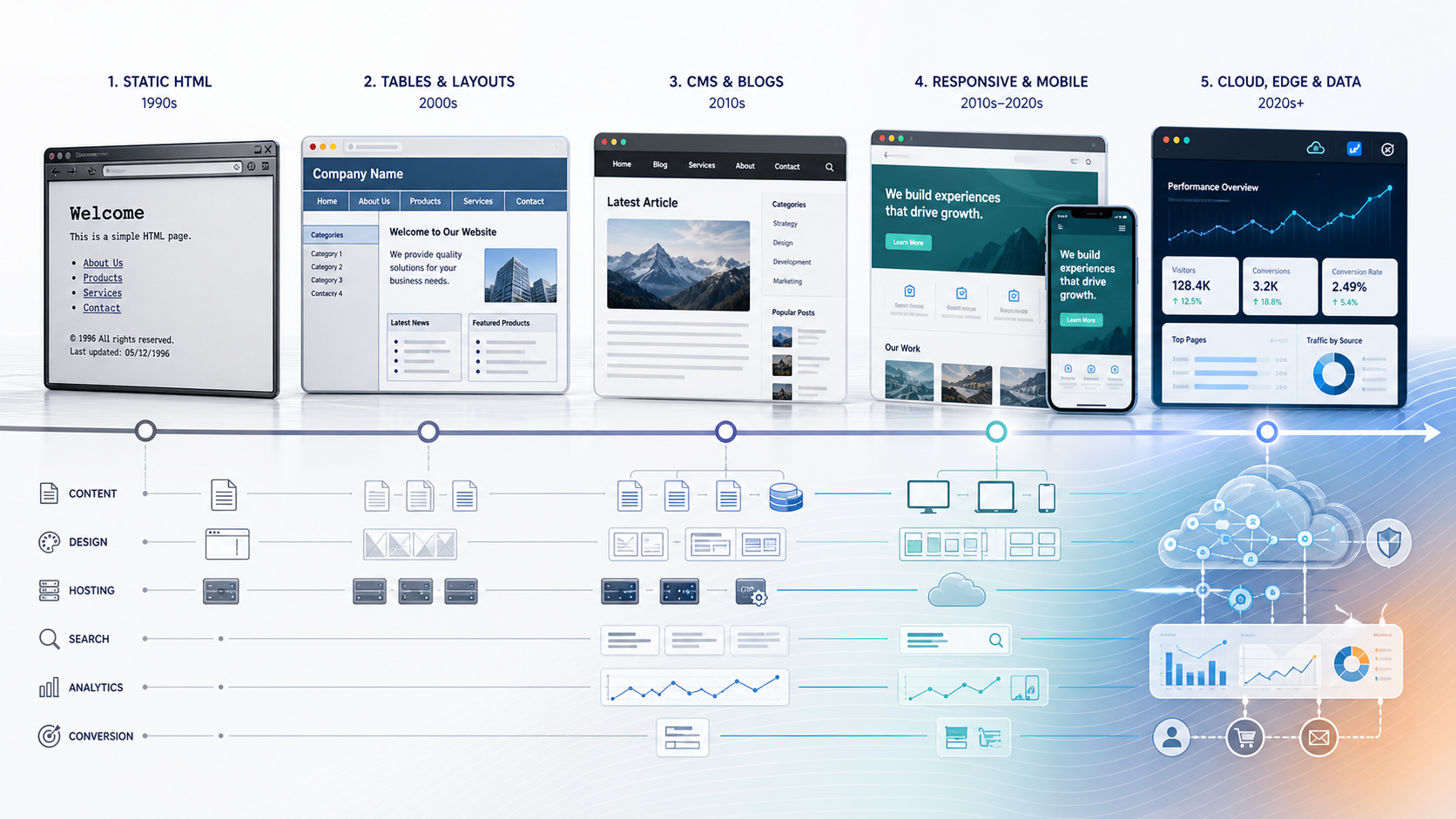
Then websites became brochures. Then destinations. Then publishing systems. Then lead-generation engines. Then customer portals. Then data sources. Then living systems connected to cloud infrastructure, search visibility, analytics, CRM workflows, security controls, and business operations.
That evolution matters because many companies still talk about websites as if they are static artifacts.
They are not.
A modern business website is part communication system, part software system, part trust system, and part operating system for the customer journey.
The Early Web Was About Presence
The first era of business websites was mostly about being reachable.
A company needed a domain, a few HTML pages, basic navigation, contact information, and enough text for someone to understand what the business did. The pages were simple. They loaded quickly. They were often plain, but they were direct.
In that era, a website was a signal that the company existed in the new digital world.
The technical model was also simple: static files on a server. No build pipelines. No analytics stack. No personalization. No content workflow. No component system. No continuous deployment. For many small businesses, updating the site meant editing files directly or asking the one person who knew HTML.
That simplicity had value.
It also had limits. As soon as websites needed frequent updates, richer content, better design, search visibility, or more business functionality, the static-page model started to strain.
The Brochure Era Made Design More Important
As more businesses came online, merely having a website was no longer enough.
The website became a digital brochure. Companies wanted pages that looked professional, matched the brand, explained services, showed products, and made the business feel credible.
This period brought more visual ambition: layouts, imagery, navigation systems, page templates, and brand consistency. It also brought some unfortunate habits: heavy pages, image-based text, table layouts, splash screens, and design choices that were difficult to maintain.
Still, the brochure era taught an important lesson.
Presentation affects trust.
A website that looked outdated or careless could weaken perception. A website that felt organized and modern could make a small business appear more established. Visual design became part of credibility.
CMS Platforms Turned Websites Into Publishing Systems
The rise of content management systems changed who could update the web.
Instead of every change requiring a developer, businesses could publish news, articles, service updates, case studies, events, resources, product information, and landing pages through an administrative interface. This made the website more dynamic operationally even when the front-end experience remained relatively simple.
The CMS era was a major step forward because it recognized that websites are not finished at launch.
They need ongoing content.
But CMS platforms also introduced new complexity: plugin ecosystems, themes, database dependencies, permissions, editor workflows, security updates, backups, and content modeling. A website was no longer just files. It was an application with an editorial layer.
This changed the operating responsibility. Businesses now needed to think about who could publish, how content was structured, how updates were reviewed, and how the platform would be maintained.
Search Made Structure Strategic
Search engines changed the purpose of many business websites.
A site was no longer only for people who already knew the company. It became a discovery surface for people searching by problem, category, location, comparison, price, or intent.
This made information architecture more important. Page titles, headings, internal links, URL structure, crawlability, content depth, performance, and redirects all affected whether the website could be found and understood.
SEO also exposed a tension.
Websites built only for internal company structure often did not match how buyers searched. A business might organize around departments while visitors searched around problems. A company might use branded language while searchers used plain language.
The best websites adapted by treating content as a strategic asset. Service pages, articles, guides, comparisons, FAQs, case studies, and location pages became part of the acquisition system.
The website became a map of buyer intent.
Mobile Changed the Interface Contract
Mobile changed expectations permanently.
Before responsive design became standard, many business websites were effectively desktop documents squeezed onto small screens. Navigation was painful. Forms were difficult. Tables broke. Images loaded slowly. Buttons were too small. Content hierarchy collapsed.
Responsive design forced teams to think in systems: flexible layouts, readable type, touch targets, adaptive navigation, image sizing, and performance across network conditions.
This was not only a design change.
It was a business change.
Visitors could now encounter the website anywhere: in a meeting, on a train, after a referral, during a store visit, from a social post, while comparing vendors, or after receiving an email. The website had to work in moments of partial attention.
Mobile made usability part of brand perception. If the site did not work on the device in the buyer's hand, the business felt behind.
Cloud Hosting Raised the Baseline
Cloud and edge platforms changed what businesses could reasonably expect from website infrastructure.
A website no longer had to depend on one small server serving every visitor from one region. Static assets could be cached globally. Media could live in object storage. Forms could use serverless functions. Databases could be managed. Deployments could be automated. Preview environments could be created for every change. Monitoring could be built into the platform.
This did not make infrastructure effortless.
It changed the baseline.
Reliability, rollback, global delivery, observability, and security controls became accessible to smaller teams. A business website could be operated more like a product system and less like a file upload.
The cloud era also introduced a new responsibility: choosing intentionally. More services do not automatically create a better website. A good architecture uses cloud capabilities to reduce friction, not to create unnecessary complexity.
Analytics Turned Websites Into Learning Systems
Once teams could measure behavior, the website became a learning system.
Which pages attract qualified visitors? Which CTAs get clicked? Which landing pages convert? Which articles support search? Which forms are abandoned? Which devices struggle? Which pages load slowly? Which campaigns drive poor-fit leads? Which content helps sales conversations?
These questions changed the website from a static deliverable into an ongoing feedback loop.
But analytics also created a new failure mode: measuring everything without understanding anything.
Useful analytics starts with business questions. The goal is not more dashboards. The goal is better decisions. A small set of trustworthy events tied to real outcomes is more valuable than a sprawling measurement system no one believes.
A living website learns because the team knows what it is trying to learn.
Security Became Part of the Experience
As websites became more connected, security became more visible.
Visitors expect HTTPS. Browsers warn users about unsafe experiences. Forms collect data. CMS platforms need updates. Third-party scripts run in the browser. Customer portals require authentication. Integrations connect to CRMs, email platforms, payment systems, and analytics tools.
Security is no longer something hidden in a server room.
It is part of the user experience.
A certificate warning, spammy injected page, broken form, suspicious redirect, or compromised plugin damages trust. Buyers may not know the technical cause, but they understand the signal: something is not right.
Modern websites need security operations proportional to the trust they request. The more the site handles data, transactions, accounts, or business-critical workflows, the more disciplined the operating model needs to be.
The Website Became a Business System
The modern business website is connected to almost everything.
Brand, content, search, campaigns, analytics, sales, support, recruiting, customer education, security, hosting, design systems, accessibility, legal requirements, and operational workflows all touch the site.
That is why a redesign cannot be treated as a cosmetic project.
Changing the website can affect search visibility, lead quality, CRM routing, campaign tracking, page speed, accessibility, analytics, customer expectations, and sales enablement. The website is not just how the business looks. It is how parts of the business work.
This is the biggest shift in the history of business websites.
The site moved from presence to infrastructure.
What Modern Brands Should Remember
The early web reminds us that clarity matters. The brochure era reminds us that presentation affects trust. The CMS era reminds us that publishing workflows matter. The search era reminds us that buyer intent should shape structure. The mobile era reminds us that usability is context-sensitive. The cloud era reminds us that reliability and speed are operational choices. The analytics era reminds us that websites should improve.
Modern brands need all of those lessons.
A website should be clear enough to understand, polished enough to trust, structured enough to find, fast enough to respect attention, secure enough to protect users, flexible enough to update, and measurable enough to improve.
That is a high standard.
It is also the standard customers increasingly expect.
Final Thought
Business websites evolved from static pages into living systems because businesses asked more of them.
They needed the site to explain, persuade, publish, rank, convert, support, measure, integrate, and adapt.
That evolution should change how teams think about website work.
A website is not finished when it launches. It is ready to begin learning. It needs ownership, maintenance, performance review, content strategy, security discipline, and ongoing improvement.
The best modern websites still honor the earliest lesson of the web: make useful information accessible.
They simply do it inside a much richer system now.