Trust Signals That Actually Help Service Businesses
Trust is built through specificity: proof, process, people, and clear expectations.
Trust is built through specificity: proof, process, people, and clear expectations.
Trust is built through specificity: proof, process, people, and clear expectations.
That matters because service businesses sell something buyers cannot fully inspect before they purchase.
A customer can look at a product, compare specs, read reviews, and often return it if it does not work. Hiring a service provider is different. The buyer is choosing expertise, communication, reliability, judgment, and follow-through. They are trusting someone to solve a problem, guide a project, or improve an outcome that may be complex and uncertain.
That uncertainty creates risk.
Will this company understand my problem? Will they communicate clearly? Will the process be painful? Will the cost change unexpectedly? Will they deliver what they promised? Will I regret choosing them?
A service business website has to answer those questions before the first conversation.
Not with vague claims.
With useful evidence.
Generic Trust Language Is Invisible
Every service business says some version of the same thing.
"We are reliable." "We are experienced." "We put clients first." "We deliver quality solutions." "We are passionate about results." "We are your trusted partner."
These statements are not necessarily false. The problem is that they are too common to be persuasive.
Visitors have seen them everywhere. They skim past them because the claims require no proof. Any competitor can say the same thing.
Generic trust language becomes invisible.
Specificity is what makes trust visible.
Instead of saying, "We are responsive," say how quickly clients can expect a reply.
Instead of saying, "We have experience," name the industries, project types, or business problems you know well.
Instead of saying, "We deliver results," show before-and-after examples, metrics, screenshots, case studies, or named outcomes.
Instead of saying, "We provide custom solutions," explain what the discovery process looks like and how recommendations are made.
Specifics reduce perceived risk because they make the business feel real.
Trust Starts With Clarity
Before a visitor can trust a service business, they need to understand it.
Many websites lose trust early because the offer is unclear. The homepage sounds polished but vague. The services page lists capabilities without explaining outcomes. The contact page asks for information but does not explain what happens next.
Clarity is a trust signal.
A visitor should quickly understand what you do, who you serve, what problems you solve, what outcomes you help create, how the process works, what the next step is, and why your team is credible.
This is especially important for service businesses where the work is technical, strategic, or consultative. IT services, cloud consulting, cybersecurity, AI implementation, marketing strategy, web design, legal services, financial services, and business consulting all require buyers to make decisions under uncertainty.
A clear website tells the buyer, "We know how to explain our work."
That matters.
If a business cannot explain its own service clearly, visitors may doubt whether the delivery process will be clear either.
Proof Beats Promises
Trust grows when a website moves from claims to evidence.
A promise says, "We can help."
Proof shows, "Here is how we have helped."
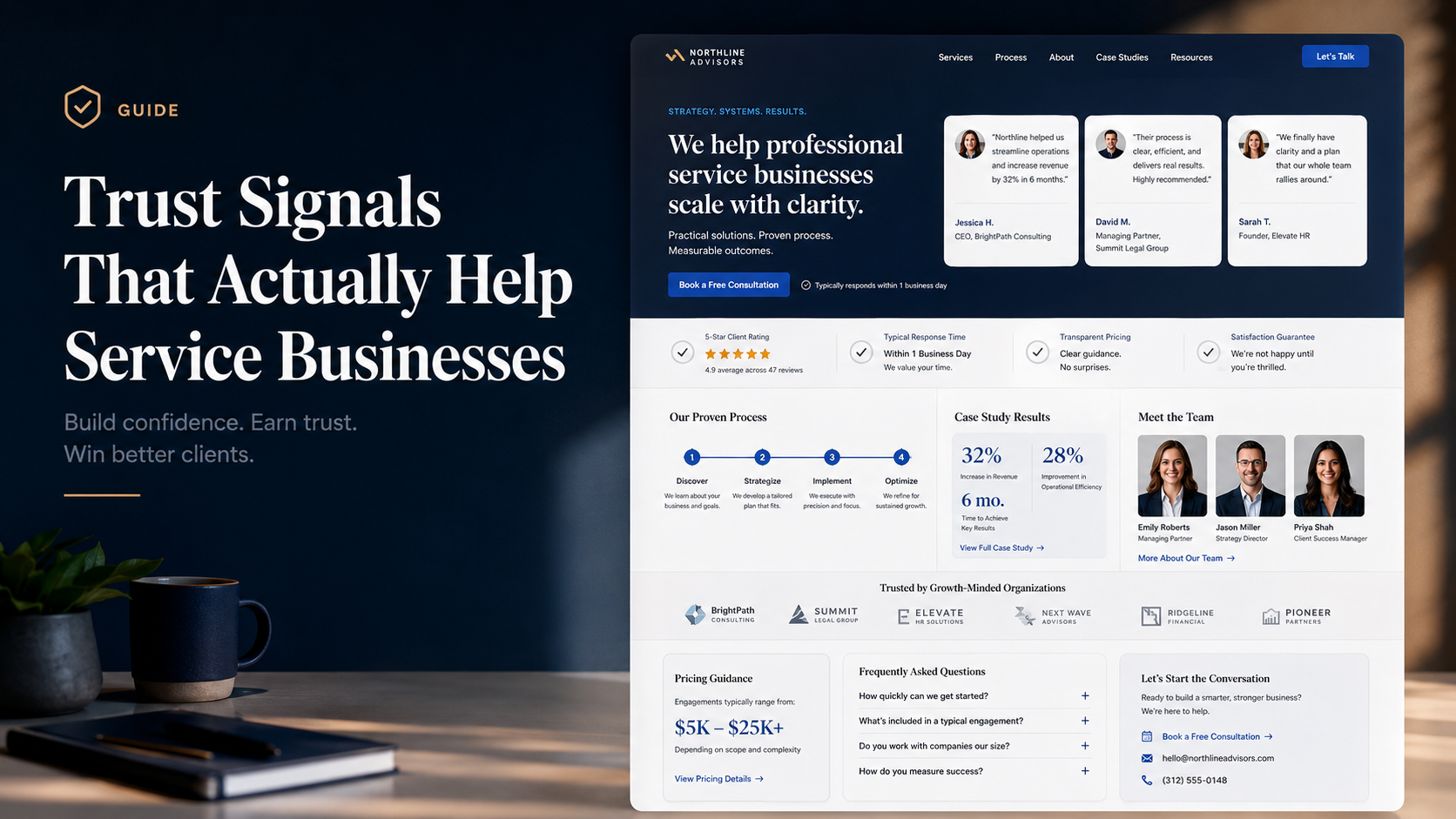
That proof can take many forms: case studies, testimonials, before-and-after examples, screenshots, project snapshots, client logos, industry experience, certifications, awards, metrics, years in business, published insights, process documentation, portfolio examples, partner badges, and real customer quotes.
The best proof is specific.
A testimonial that says, "Great company to work with" is better than nothing, but it does not reveal much. A testimonial that explains the problem, the experience, and the outcome is much stronger.
For example:
"The team helped us migrate our customer portal without disrupting daily operations. They mapped the risks early, communicated weekly, and reduced page load times by 40% after launch."
That kind of proof does several things at once. It shows competence. It shows process. It shows communication. It shows an outcome. It gives the visitor something concrete to believe.
Service businesses should not hide proof on a separate page and hope visitors find it. Proof should appear near the claims it supports.
If you say you improve performance, show a performance example. If you say you simplify operations, show what changed. If you say you understand a specific industry, show relevant work. If you say clients trust your process, show what that process includes.
Proof works best when it is placed where doubt appears.
Process Is a Trust Signal
People hire service providers when they believe the provider can lead them through ambiguity.
That makes process one of the most important trust signals on a service business website.
A clear process answers the buyer's quiet fear:
"Will this be painful?"
Many buyers are not only worried about the final result. They are worried about the experience of getting there. They wonder how much time the project will take, who needs to be involved, what decisions they will have to make, how communication will work, and whether the provider will create more confusion than they solve.
A process section helps reduce that anxiety.
It does not need to be complicated. In fact, it should not be.
A simple process might explain discovery call, assessment or audit, recommendations, proposal and timeline, implementation, review and optimization, and ongoing support.
The goal is not to turn the website into a project manual. The goal is to help buyers imagine working with you.
A clear process tells visitors, "We have done this before, and we can guide you."
That is often more persuasive than another decorative section.
Clear Expectations Reduce Friction
Trust is also built by telling people what to expect.
Many service websites hide too much. They avoid discussing pricing. They do not explain timelines. They do not say who will respond after the contact form is submitted. They do not clarify whether the first call is exploratory, paid, or consultative. They do not explain what information the buyer should bring.
This creates uncertainty.
And uncertainty slows action.
Clear expectations can improve conversion because they make the next step feel safer.
A strong contact page might say: "After you submit the form, we will respond within one business day." "Your first call is a 30-minute fit conversation." "You will speak directly with a senior consultant." "We will ask about your goals, timeline, current challenges, and decision process." "If we are not the right fit, we will say so." "Most projects begin with a discovery phase before implementation."
Those details may seem small, but they make the interaction feel more accountable.
The same applies to pricing.
Not every service business can publish fixed prices. Custom projects vary. But that does not mean the website has to say nothing.
A pricing page or section can explain typical starting ranges, what affects cost, common engagement models, what is included, what is not included, how proposals are created, when recurring fees apply, and what clients should budget for.
Pricing clarity is a trust signal because it respects the buyer's time.
Show the People Behind the Work
Service businesses are built on people.
Even when technology, systems, and processes are involved, buyers still want to know who they are trusting.
A faceless website can feel efficient, but it can also feel distant. A service business does not need to overshare or turn every team member into a personal brand. But it should give visitors enough human context to feel accountable.
That can include real team photos, founder or leadership bios, named points of contact, author bylines on articles, short videos, a clear company story, direct human language, team credentials, community involvement, and behind-the-scenes project thinking.
A small team can signal credibility just as effectively as a large one.
Sometimes more effectively.
Small teams can show direct involvement, senior attention, specialized expertise, and personal accountability. The key is to avoid hiding behind generic corporate language.
Trust grows when the site feels like real people stand behind the work.
Thoughtful Writing Is a Trust Signal
A service business can also build trust through how it explains ideas.
Thoughtful writing shows how a company thinks. It gives buyers a preview of judgment, communication style, and expertise.
This is why articles, guides, FAQs, comparison pages, and service explainers can be so valuable. They do more than support SEO. They help visitors evaluate whether the team understands the problem.
A strong article can show that a provider knows the tradeoffs. A useful FAQ can answer objections before a sales call. A detailed service page can show maturity. A comparison page can help buyers make a more informed decision. A clear case study can show problem-solving ability.
The best service businesses do not only say, "We are experts."
They demonstrate expertise in public.
That does not mean writing dense technical content for its own sake. It means explaining the work in a way that is accurate, useful, and relevant to the buyer.
Clear thinking creates trust.
The Best Trust Signals Are Close to the Decision
Trust signals should not be sprinkled randomly across a website.
They should appear where the visitor needs reassurance.
On the homepage, trust signals should quickly establish relevance and credibility. This might include industries served, outcome statements, recognizable clients, or a strong positioning statement.
On a service page, trust signals should support the specific offer. This might include process details, deliverables, FAQs, related case studies, and proof that the team has solved similar problems.
On a pricing page, trust signals should reduce financial uncertainty. This might include what is included, what changes the price, engagement options, and common scenarios.
On a contact page, trust signals should reduce anxiety about reaching out. This might include response time, who will respond, what happens next, and whether the consultation has a cost.
On a case study page, trust signals should show the full arc: problem, approach, outcome, and what the team learned.
The closer a visitor gets to taking action, the more important specificity becomes.
What Actually Reduces Risk
Strong trust signals reduce one or more types of buyer risk.
Performance risk: can this provider actually do the work? Use case studies, portfolio examples, technical credentials, outcome metrics, and before-and-after examples.
Process risk: will working with them be confusing or painful? Use process timelines, onboarding details, communication expectations, project phases, and clear responsibilities.
Financial risk: will the cost be unclear or unreasonable? Use pricing ranges, engagement models, scope explanations, and proposal criteria.
Social risk: will I look bad for choosing them? Use testimonials, client logos, industry experience, referrals, and recognizable proof.
Time risk: will this take longer than expected? Use timelines, milestones, availability expectations, and project planning details.
Trust risk: are these real people who will be accountable? Use team bios, real photos, founder notes, named contacts, and direct language.
The strongest websites understand which risks matter most to their buyers and address them directly.
Trust Signals That Often Do Not Help
Not every trust signal is useful.
Some are too vague. Some are outdated. Some feel performative. Some create clutter without reducing risk.
Common weak trust signals include generic stock photos of meetings, unverified "trusted by many" claims, vague awards with no context, testimonials with no names or details, icons that say "quality," "integrity," or "innovation" without proof, overused phrases like "client-focused solutions," security badges that do not apply to the buying decision, large numbers with no explanation, fake urgency, and overly polished copy that says little.
The problem is not that these elements are always wrong. The problem is that they often ask the visitor to trust without giving them a reason.
Good trust signals are specific, relevant, and verifiable.
They should make the visitor think, "This company understands my situation."
Accountability Is the Real Signal
At the heart of trust is accountability.
A trustworthy service business website feels like someone is willing to stand behind the work.
That comes through in direct language. It comes through in clear offers. It comes through in transparent next steps. It comes through in named people, real examples, and honest explanations.
Accountability also means knowing what not to promise.
A credible service business does not guarantee unrealistic outcomes. It does not pretend every project is simple. It does not hide tradeoffs. It does not use complexity to confuse the buyer.
In fact, honest limitations can build trust.
For example: "We are not the best fit for one-day rush projects." "We usually begin with an assessment before recommending implementation." "We work best with teams that have a clear internal decision-maker." "Pricing depends on scope, but most projects fall into these ranges." "If we are not the right partner, we will recommend another path."
This kind of language may filter out some leads, but it often strengthens the right ones.
Trust is not about attracting everyone.
It is about helping the right buyers feel safe enough to take the next step.
A Practical Trust Signal Checklist
For a service business website, review each important page and ask:
Can visitors understand what we do within a few seconds? Do we explain who we serve and what problems we solve? Do we support claims with proof? Do testimonials include real details? Do we show relevant examples of our work? Do we explain the process clearly? Do we set expectations for timelines, pricing, and communication? Do we show real people behind the business? Do we answer common buyer concerns before the sales call? Do we make the next step feel safe and clear? Does the site sound accountable? Could a competitor say the exact same thing?
That last question is especially useful.
If a competitor could copy your trust language without changing much, it is probably too generic.
Make it more specific.
Final Thought
Trust is not built by saying "trust us."
It is built by reducing uncertainty.
For service businesses, that means showing proof, explaining process, introducing people, and setting clear expectations.
Generic claims are easy to ignore. Specific details are harder to dismiss.
A strong website helps buyers feel that the provider understands the problem, knows how to lead the process, communicates clearly, and will be accountable after the first conversation.
That is what real trust signals do.
They do not decorate the page.
They lower the perceived risk of taking the next step.
And for a service business, that can make all the difference.